

How medical animation can help you raise pharma investment & win over VCs

Share:

Copy link

Share via Telegram

Share on Facebook

Share on LinkedIn

Share via WhatsApp

Share on X

Share via Email

Table of contents
Even the most innovative therapies can fail to win funding.
You may have promising clinical data or a breakthrough drug candidate. But when it’s time to pitch investors, one major challenge often appears: explaining science to people without a scientific background.
Most venture capitalists (VCs) are financial experts, not molecular biologists. They won’t fund what they can’t understand.
This is where medical animation can change the conversation. In this article, we explain how pharma and biotech companies use 3D videos to win investor attention and de-risks their decisions.
What makes biotech fundraising so challenging
Biotech and pharma are among the most difficult industries to evaluate. Let’s break down some of the biggest concerns investors have during fundraising.
1. Dependence on science
Unlike software or retail products, biotech innovations are difficult to evaluate quickly. Investors can’t physically see how a drug works or easily measure its value through market trends alone.
Most biotech companies rely on complex clinical and scientific data to prove that a therapy is effective. But for non-scientific audiences, this information is difficult to understand. As a result, even promising therapies may appear uncertain or too risky to fund.
2. Excessively long "time-to-market" timelines
As of 2026, the traditional pharma and biotech development cycle typically takes from 10 to 15 years. Even with AI implementation and new development models reducing it by 40–50%, we are still talking about multi-year-long timelines.
For investors, that means years of uncertainty before a product becomes commercially viable. And even after regulatory approval, success still depends on market conditions, competition, pricing, and adoption.
3. Harsh regulatory rules
Even successful clinical trials don’t guarantee that a therapy will reach the market. The final stage is regulatory approval.
For example, in the European Union, multiple regulatory reviews can take roughly 12-18 months. The United States provides shorter timelines for some discoveries, yet they still can last for many months.
This creates another layer of uncertainty for VCs. A therapy may show strong clinical results but still face delays or approval challenges before launch.
4. High cost of failure
In biotech and pharma, failure is not just financial. Unexpected safety issues and unsuccessful trials may affect patient health and the company's reputation.
Because of this, investors tend to approach biotech funding much more cautiously than many other industries.
How medical animation supports biotech fundraising
For a clinical-stage pharmaceutical company, medical animation is a strategic asset designed to de-risk the investment. There are several ways it can help.
1. Making the MoA instantly understandable
High-stakes investment often depends on how quickly a stakeholder can grasp a drug's unique value proposition.
The mechanism of action (MoA) is one of the most important parts of any biotech pitch. It explains exactly how your molecule identifies, binds to, and modifies its target, showing how the medicine deals with a disease. But static diagrams and scientific data make complex mechanisms difficult to follow.
A 3D MoA animation, however, provides a microscopic view that guides investors inside the human body, translating complex physiological processes into a clear, visual narrative. This leads to an intuitive understanding of these processes even by non-scientists.
2. Interpreting preclinical & clinical trials data efficiently
Data is obligatory for pharma investments. But large volumes of charts, endpoints, and statistical results are difficult to process quickly.
3D biotech animation acts as a bridge, bringing the data from preclinical and clinical trials to life. For instance, animation can visualize drug distribution, receptor activity, or physiological response over time. It allows investors to assess the drug's efficacy and safety, making the data feel more validated and less abstract during due diligence.
As a result, you partially reduce “dependence on science”, making the essence of your innovation clear and explaining its clinical value.
3. Reducing cognitive load during investor evaluation
VCs have the same attention span limitations as anyone else. Their working day is filled with calls or boardroom presentations, so their problem of cognitive overload and distraction occurs.
3D medical animations reduce this cognitive load by organizing complex information into an optimized visual hierarchy. This allows investors to immediately focus on the strategic potential of the drug rather than struggling to decode technical jargon or interpret static diagrams.
This clarity is crucial because an engaged investor asks more relevant questions, stays in the meeting longer, and is more likely to advocate for your company during internal partner meetings.
4. Demonstrating market readiness and professionalism
Presenting a medically accurate and quality 3D animation of your pharmaceutical product signals that your company is prepared to communicate its science and has the resources to commit to it.
This effect extends to the science itself. If the presentation is high-quality, the investor is more likely to believe the laboratory work is high-quality too.
As a result, you enhance the level of trust, showing that you are a trustworthy partner who values the time and money of VC representatives.
Additionally, the same 3D content can be used in regulatory pipelines as an additional supporting material. For a pharma company, a visual demonstration of their new drug’s value can be a sufficient aid during regulatory reviews. So, they not only convince the investor of market readiness but also ensure them that the product has a higher chance of final approval.
Where to use medical animation during the fundraising cycle
To maximize the return on your investment in animation, it should be treated as a multi-channel asset that you can use across the entire fundraising lifecycle.
The pitch deck
In early meetings, investors are still forming their understanding of your therapy. This is where clarity matters most.
At this point, animation works best after the clinical need and context are established. Use a 60-90 second MoA clip to translate the mechanism from abstract biology into a clear visual sequence, making the link between disease and solution easier to grasp.
Investor relations (IR) website
Modern investors look for the pharma company’s info about the product long before the first meeting.
A dedicated investor relations website featuring a high-quality video of your mechanism of action allows potential investors to self-educate. It ensures that even when you aren't in the room, your science is being communicated accurately and compellingly.
Roadshows and conferences
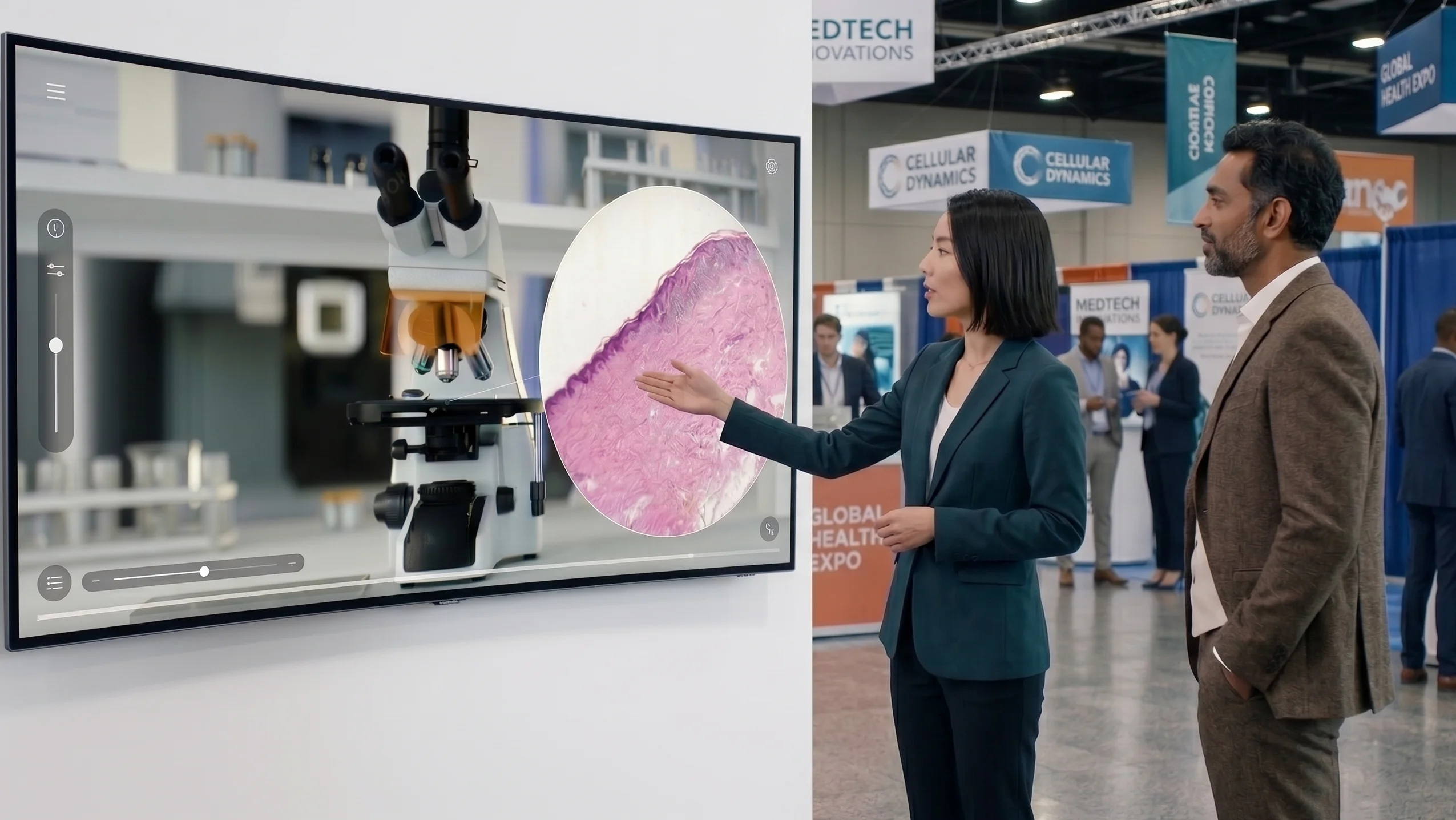
At major industry events, you are competing with hundreds of other companies for a few minutes of an investor's time.
A high-quality and engaging marketing visuals on a tablet or a large screen is one of the most effective tools available. It presents your entire value proposition in a visual format that can be consumed in the time it takes to walk past a booth.
Conclusion: de-risking the investment with visual clarity
In biotech fundraising, investment decisions often come down to one factor: how clearly the science is understood. So, a 3D medical animation becomes a strategic investment in clarity.
For a clinical-stage pharmaceutical company, the cost of producing a high-end visual asset is a tiny fraction of a $20M or $50M funding round. Yet, it is often the very thing that tips the scale, transforming a skeptical VC into a committed partner. By investing in visual clarity, you aren't just making a video, but de-risking your future.
Preparing for your next funding round? Contact VOKA to create a visually stunning animation that captures the imagination of VCs and gets your pitch deck the attention it deserves.
FAQ
1. Why do biotech startups need medical animation for investors?
In short, medical animation reduces confusion. And in biotech fundraising, less confusion means faster investment decisions. Though investors don’t see molecules, pathways, or receptor interactions the way scientists do, they still need to quickly understand how therapy works and why it matters. Animations help bridge that gap by turning complex biological mechanisms into a visual story that’s easier to grasp and remember.
2. Can an MoA animation replace my standard pitch deck?
An animation should not replace a pitch deck, but rather act as one of its cores. While a deck covers the market size, team, and financial projections, the animation handles the explanation part. It is best used as a centerpiece that breaks up the slide presentation, providing a high-impact emotional and intellectual "hook" that stays with investors long after the meeting ends.
3. At what stage of funding should a biotech or pharma company invest in 3D animation?
The most critical time to invest in high-fidelity 3D animation is during Series A and Series B rounds. At these stages, the valuation is significantly higher, while the competition dramatically intensifies. Investing in professional visualization at this point shows that the company is serious about promoting its product and is well-equipped to support a multi-million dollar clinical trial phase.
4. What is the ROI of 3D medical animation for investor relations?
The ROI of 3D animation is measured in "time to understanding" and "capital efficiency". By shortening the time it takes for an investor to grasp the drug’s potential, you shorten the overall fundraising cycle. Furthermore, a professional medical animation boosts sales and ROI, because the same asset can be repurposed for medical congresses, clinical trials, and eventually, product launch marketing.
5. How long should an investor pitch animation be?
The ideal length is 60 to 120 seconds. This is enough time to illustrate the mechanism of disease, show the drug entering the system, and highlight the successful interaction at the cellular level.
6. How much does it cost to create a biotech 3D medical animation?
The cost of a biotech 3D medical animation typically ranges from $8,000 to $15,000 for simple projects. At the same time, more complex, cinematic-grade productions featuring intricate molecular dynamics often fall between $30,000 and $40,000. Final pricing depends on the level of visual fidelity, the duration of the video, and the amount of custom biotechnology processes that need to be modeled from scratch. To get an accurate estimate tailored to your specific requirements, you can use our 3D medical animation cost calculator for an immediate budget breakdown.
Make VOKA your preferred source
See more VOKA articles in Google Search

Share
Table of contents

Thank you for your comment!
Your comment has been submitted for moderation and will be published soon. We'll email you once it’s live.