

How to maximize medical animation ROI in 2026: quarterly roadmap

Share:

Copy link

Share via Telegram

Share on Facebook

Share on LinkedIn

Share via WhatsApp

Share on X

Share via Email
Table of contents
Creating high-quality medical animation is costly. And the first question that follows once it’s produced: Will it pay off?
That question is valid as companies naturally expect measurable business impact, or so-called return on investment (ROI).
Since VOKA works closely with medtech and pharma marketing teams, we approach this topic from a commercial perspective. In this guide, we’ll shed light on the following questions: What exactly counts as ROI in the context of medical animation? When should you expect returns? And how to use medical animation to boost ROI and sales?
With that context in mind, let’s discuss what medical animation ROI truly means, and how to engineer it intentionally rather than just hope for it.
What is medical animation ROI?
Medical animation ROI simply means this: does the money you invested in a 3D medical animation generate more value than it costs?
Before answering that, it’s important to understand your medical animation cost, since ROI always depends on the size of the initial investment. Say, you spend $25,000 on a medical animation, and if it helps you close additional deals, accelerate sales cycle, or eliminate prototype shipping costs, that difference is your return.
At its core, the formula is straightforward: ROI = (Revenue gain − Investment cost) / Investment cost
If the result is positive, the investment paid off. The higher the number, the stronger the return.
But in healthcare and medtech marketing, ROI is not always immediate or direct. A medical animation might:
-
Help sales teams explain complex medical concepts
-
Improve closing rates during product demonstrations
-
Reduce onboarding time for new sales representatives
-
Replace expensive physical samples or repeated video shoots
-
Improve conversion rates on landing pages
Each of these outcomes contributes to ROI, even if they don’t appear as a single line item in your revenue report.
When does medical animation ROI start to show?
Medical animation ROI rarely appears overnight. The timing depends on how and where the animation is used.
Early-stage ROI: Sales-level impact
In many medtech companies, the first signs of ROI show up almost immediately after launch. As soon as the animation is integrated into:
-
Sales meetings
-
Product demos
-
Distributor presentations
-
Congress booths
It begins influencing conversations.
A well-crafted 3D medical animation can help representatives explain sophisticated mechanisms in minutes instead of lengthy technical discussions. That clarity builds confidence, shortens meetings, and often accelerates decision-making.
Mid-term ROI: Marketing performance
When animation is deployed across marketing channels, companies begin to see measurable performance shifts, for instance:
-
Higher landing page engagement
-
Improved demo requests
-
Better-qualified leads
-
Increased demo-to-close ratios
This is where ROI becomes trackable through marketing and CRM data. Your animation starts contributing to measurable pipeline growth.
Long-term ROI: Asset compounding
Long-term ROI develops over time. High-quality medical animation is rarely a one-time asset. It can be reused for onboarding, product updates, and training programs.
Over 12-24 months, its value compounds as production costs stay fixed while usage expands.
Key takeaway: In short, medical animation ROI begins the moment the animation starts influencing decisions, but its full impact unfolds over time. The key is not waiting for ROI, but planning it from the start.
4 Core drivers of medical animation ROI

Stunning graphics may capture attention, but they don’t guarantee revenue. ROI is driven by how strategically the animation is positioned, deployed, and scaled.
Below are the four core drivers that determine if your animation becomes a revenue-generator:
Deployment strategy: where the animation is used
The same animation can produce radically different outcomes depending on where it appears.
If it lives only on a website homepage, its impact is limited. If it’s integrated into sales decks, investor presentations, congress booths, and product training, its influence multiplies.
ROI increases when the animation is embedded into several revenue-critical touchpoints.
Audience focus: who the animation is created for
An animation designed for clinicians should not look or sound like one built for C-level executives or patients.
C-level executives care about value and market potential, while clinicians focus on mechanism, safety, and clinical outcomes. Patients need clarity and simplicity to understand medical topics faster.
When messaging aligns with the audience’s priorities, decisions are made quickly.
Distribution channels: how widely it’s activated
Medical animation should not be single-channel. It can support sales meetings, industry events, landing pages, email campaigns, and more.
The broader the distribution, the more opportunities the animation has to influence decisions and generate returns.
Lifecycle planning: how long it delivers value
When animation is created with a modular structure, future edits become easier. Scenes can be repurposed into shorter clips. Localization for new markets becomes cost-efficient. Product updates require adjustments, not full re-production.
Lifecycle planning transforms animation from a launch expense into a long-term business asset.
Where to use medical animations to boost ROI
Medical animations are most effective when deployed across multiple channels. Below are the most common and high-impact applications:
Events: conferences and trade shows
Animations grab attention on busy trade show floors, explain complex MoA (mechanism of action) at pharma events, and support live demonstrations. They make booths more engaging, reduce the need for physical prototypes, and provide consistent visual storytelling for every attendee.
Sales communication: presentations and meetings
Integrating animations into sales decks allows sales reps to demonstrate product mechanisms and clinical benefits visually. This accelerates the sales cycle, increases closing rates, and ensures a standardized, high-quality message across the entire team.
Investor pitches
Investors need to quickly understand the product and its market potential. Medical animations make intricate technology digestible, increase confidence in the innovation, and help convey competitive advantage in a visually compelling way.
Digital marketing: website, emails, and social Media
Animations improve engagement on landing pages, reduce bounce rates, and increase demo requests. Short clips can be repurposed for social media campaigns or embedded in email subject lines to boost open and click-through rates. This expands ROI by leveraging one animation across multiple digital touchpoints.
Education: student, patient, and HCP training
Animations are invaluable for teaching medical students, clinical staff, and patients. They can simplify complex physiology, demonstrate proper device use, or illustrate the mechanism of action without requiring live demonstrations. High-quality 3D animations reduce training time and improve retention.
Q1-Q4 roadmap: maximizing ROI in 2026
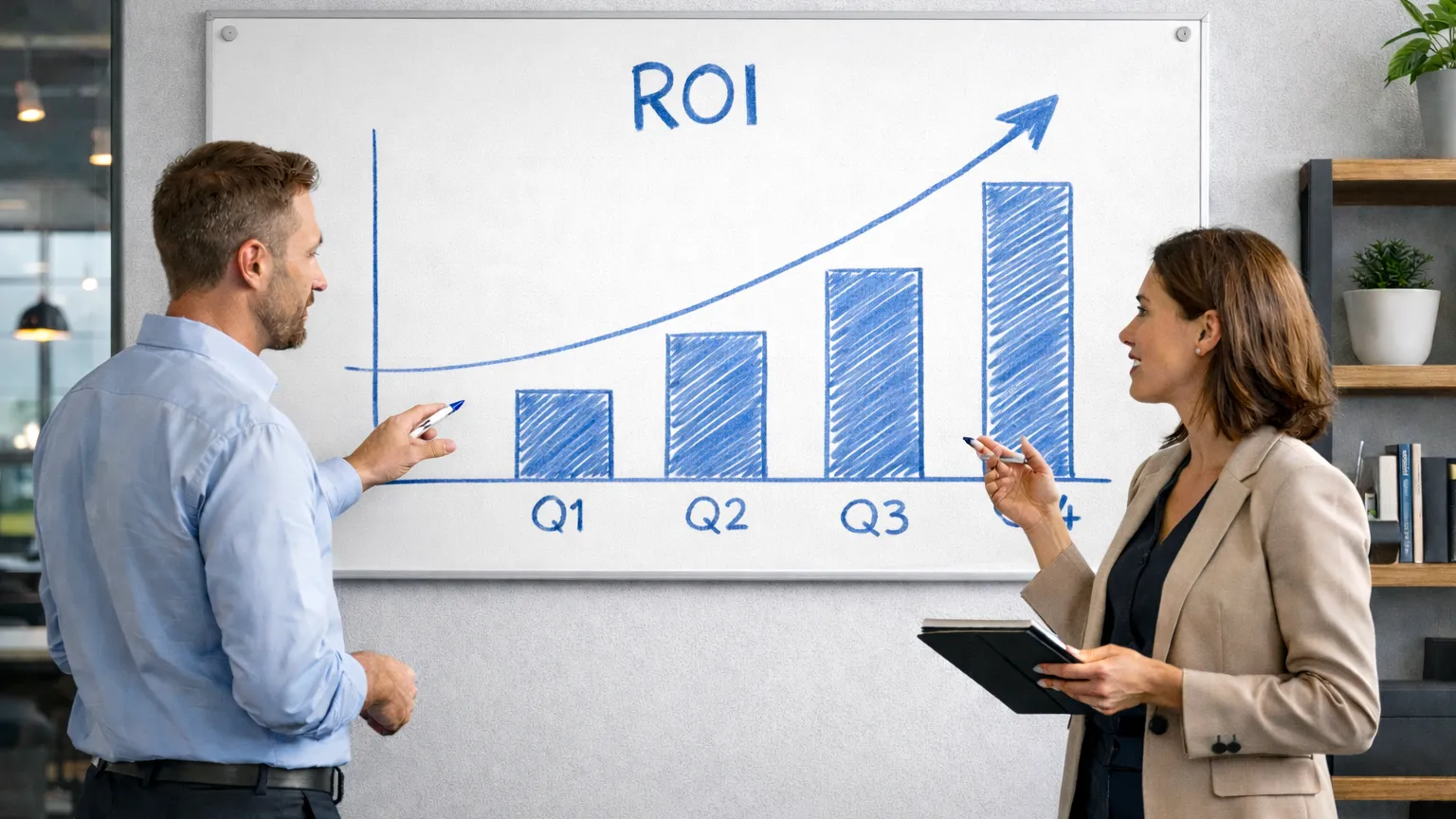
With the right strategy, medical animation can start influencing sales conversations within months and generate measurable ROI by year-end.
Q1: Strategic planning & KPI definition
Before scripting a single frame, define what success actually means for your business.
Define revenue goals
Are you launching a new device? Entering a new market? Supporting distributors? Set specific targets. For example, “Increase demo-to-close rate by X%” or “Shorten sales cycle by X days.”
If the revenue impact is unclear at this stage, ROI will be difficult to measure later.
Define cost-reduction goals
ROI is not driven solely by revenue. In many medtech organizations, a significant portion of returns comes from operational efficiency.
Medical animation can reduce reliance on physical prototypes that are expensive to produce, ship, and maintain. It can decrease the need for repeated in-person training sessions by delivering consistent, visual explanations on demand. Or, it can minimize the logistical burden of live demonstrations, especially when products are large or difficult to transport.
Define in advance which expenses the animation is expected to replace, streamline, or eliminate. When those savings are tracked alongside revenue impact, ROI becomes clearer.
Align with sales early
Sales teams know the real objections buyers raise. Involve them before production begins:
-
What confuses prospects?
-
What slows down decisions?
-
Where do deals typically stall?
Animation should address real sales friction, not just theoretical messaging.
Pre-plan distribution
Before production begins, decide where and how the animation will be used. Will it live on high-intent website landing pages? Be embedded into sales decks for live meetings? Run on screens at trade shows? Support email campaigns?
Each placement serves a different strategic purpose and influences a different audience. Planning this ensures the animation is formatted for real-world use across those environments.
Establish tracking metrics
If ROI is the goal, start by determining how performance will be evaluated. The tracking criteria should include:
-
Conversion rates
-
Engagement time
-
Demo bookings
-
Close ratios
-
Sales cycle length
Each of these indicators reflects a different layer of impact: healthcare marketing efficiency, sales acceleration, or revenue growth. With clear benchmarks in place, performance becomes measurable and defensible at the executive level.
Q2: Production with ROI in mind
Now the animation production process begins, but it should not be treated as a purely creative phase. Every scripting, structural, and technical decision must support measurable business outcomes.
First, the script must align with real buyer objections. The narrative should directly address the concerns that delay decisions: clinical safety, comparative advantages, cost-effectiveness, and workflow integration. When animation resolves friction points that sales teams encounter every day, it becomes a persuasion tool.
Second, structure matters. By designing the animation in modular segments, each scene can stand on its own. This makes it easy to create shorter clips, tailor content for different audiences, localize for new markets, or update specific sections without having to redo the entire animation. A modular approach extends the animation’s lifespan and reduces future production costs.
Third, plan for multiple formats from the outset. A silent loop for trade shows, a full-length sales version, a shorter digital cut for landing pages, and a streamlined investor edit each serve different purposes. Creating these variations during production is far more efficient than retrofitting them later.
Q3: Deployment & revenue activation
By Q3, your medical animation is ready to go and drive results. The focus now is on putting it into the hands of the right people and in the right context.
-
Sales training. Make sure reps know how to use the animation strategically — which scenes handle specific objections, where to pause, and how to guide the conversation. Confident usage leads to smoother meetings and faster deal progression.
-
Events and trade shows. In crowded environments, a clear 3D animation grabs attention instantly. It simplifies complex mechanisms, delivers a consistent message, and can even reduce reliance on bulky physical prototypes.
-
Digital campaigns. Embed the animation into landing pages, demo funnels, and email campaigns. Strong visuals increase engagement, encourage demo requests, and move prospects further down the pipeline.
-
Performance tracking. Monitor demo bookings, engagement rates, close ratios, and sales cycle length. Early data shows what’s working — and what to refine before Q4 optimization.
In short, Q3 is where your animation shifts from a finished product to an active revenue tool.
Q4: Optimization & scaling
By Q4, it’s time to optimize and scale impact, turning early results into long-term ROI.
A/B testing
Start with A/B testing. Compare different versions of your animation — full-length vs. shorter cuts, placement on different landing pages, or alternative messaging — to see which performs best. Small adjustments can lead to noticeable improvements in engagement, demo requests, and conversions.
Localization
Next, consider localization. Translating voice-overs or adding subtitles allows the animation to reach new markets without rebuilding the animation from scratch. This expands reach and maximizes the value of your initial investment.
Repurposing
Medical video repurposing is another key step. Modular segments from the animation can be turned into short clips for social media, GIFs for email campaigns, still frames for brochures or posters, or educational micro-videos for training.
Measuring conversion lift
Look at engagement, demo requests, lead quality, and closed deals before and after the animation’s deployment. This shows how much value the animation has actually contributed to your medical sales and marketing efforts.
Calculating ROI
Finally, calculate the actual ROI. Compare the revenue and cost savings generated by the animation against the initial investment. By this point, ROI is tangible, measurable, and ready to inform your next cycle of production and deployment.
Common mistakes that kill medical animation ROI
Even the best-looking medical animation won’t deliver results if it’s not used strategically. Here are some common mistakes that often waste time and money (and how to avoid them).
Mistake 1: No clear goals or KPIs
If you don’t define what success looks like, you’ll never know if the animation is working.
Solution: Set measurable targets from the start. For example, demo requests, engagement time, close rates, or shortened sales cycles. Clear KPIs give you something real to track and improve.
Mistake 2: Using animation in only one place
A video stuck on a website or in a single sales deck misses its full potential.
Solution: Plan multichannel marketing strategy from day one. The broader it’s used, the more ROI it generates.
Mistake 3: Forgetting about sales teams
Even the most persuasive animation won’t help if reps don’t know how to use it.
Solution: Train your teams on when and how to show the animation. Make sure they understand which scenes address specific objections and how to guide discussions visually.
Mistake 4: Not tracking results
Without measurement, ROI is just guesswork.
Solution: Track engagement, demo bookings, close rates, and sales cycle length. Use real data to see what’s working, optimize underperforming channels, and prove ROI to leadership.
Mistake 5: Focusing only on visuals
Beautiful graphics alone don’t close deals or speed up sales.
Solution: Pair visual quality with strategy. Make sure your animation is aligned with the audience, addresses objections, and is used across the right channels.
Why partner with VOKA for your visual strategy?
Medical animation delivers ROI only when it combines scientific credibility, commercial thinking, and structured deployment. VOKA approaches visual strategy with all this in mind:
-
Deep medical expertise: VOKA specializes exclusively in scientific and 3D medical visualization. Our team includes in-house medical specialists, skilled 3D artists, and product experts to ensure visual precision meets project goals.
-
Commercial mindset: We don’t just ask, “How will this look?” We ask, “What objection does this solve? What decision does this support?” Every animation is built around business outcomes.
-
Strategic deployment planning: From the start, we define how the animation will function across various channels, including sales decks, trade shows, landing pages, and more.
-
Future-proof production: Scenes are structured for reuse, localization, updates, and repurposing — protecting long-term ROI and reducing future production costs.
With VOKA, your animation isn’t just a creative asset but a strategically engineered tool designed to deliver measurable results in medical markets.
If you’re ready to turn your complex innovation into a compelling visual story, contact us today. The VOKA team is here to help you build medical animations that drive real business results.
Wrapping up
Medical animation ROI doesn’t come from visuals alone. It comes from strategy.
When medical animation is aligned with business goals and used across sales, marketing, events, and training, it becomes a powerful multi-channel asset that consistently delivers value.
The real shift is this: 3D animation shouldn’t be seen as an expense, but as a long-term investment in brand authority, sales enablement, and sustainable growth.
FAQ
1. Is the initial cost of medical animation worth the investment?
In many cases, yes. A well-deployed animation can shorten sales cycles, reduce the need for physical prototypes, and lower repetitive training costs, which often offset the initial investment faster than expected. The key is strategic use, not just production.
2. Does the complexity of my product justify a 3D animation?
The more complex your mechanism of action or medical device, the greater the need for visual clarification. If your team spends significant time explaining how something works, that’s usually a strong indicator that 3D animation can create immediate value.
3. How do you ensure scientific accuracy in marketing animations?
Scientific accuracy starts with the right team. At VOKA, medical professionals work in-house alongside experienced 3D animators and marketing strategists, ensuring every visual is clinically precise and commercially effective.
4. How long does it take to produce a high-quality 3D medical animation?
Timelines vary depending on complexity, level of detail, and approval cycles. Most high-quality projects take anywhere from a few weeks to a couple of months, but a structured production process ensures timely delivery without compromising scientific accuracy.
5. Can a 3D medical animation be updated if our device or formulation changes?
Yes, and this is a major advantage for maximizing ROI. Unlike live-action videos, 3D digital assets are highly flexible and can be updated, localized, or modified for future product iterations without rebuilding everything from scratch.
6. Where are the best places to use medical animations for maximum ROI?
The highest returns typically come from interactive sales presentations, trade show displays, website landing pages, and targeted email campaigns. The real impact comes from repurposing the same animation across multiple channels to maximize reach and performance.

Share
Table of contents
Thank you for your comment!
Your comment has been submitted for moderation and will be published soon. We'll email you once it’s live.