

VOKA 3D Anatomy & Pathology vs BioDigital Human: features and functionality comparison

Share:

Copy link

Share via Telegram

Share on Facebook

Share on LinkedIn

Share via WhatsApp

Share on X

Share via Email
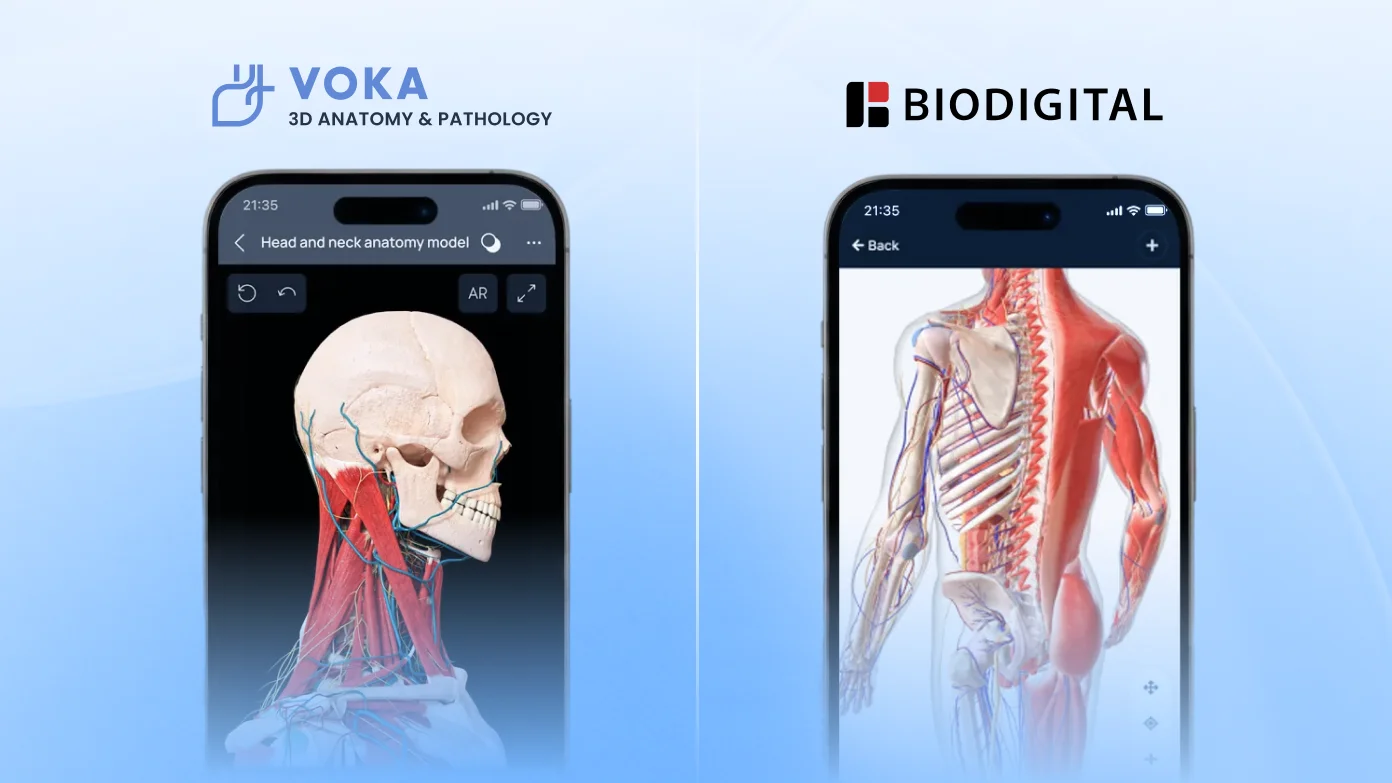
Table of contents
Interactive 3D anatomy platforms are indispensable in modern medical education and clinical practice. Why? Because they help people explore the human body and its many pathologies in dynamic ways that traditional atlases simply can’t provide.
Here, we’re continuing our series where we compare VOKA 3D Anatomy & Pathology with other well-known 3D anatomy platforms. Previously, we explored how VOKA stacks up against Complete Anatomy and Human Anatomy Atlas. In this review, we turn to BioDigital Human.
While both VOKA and BioDigital aim to make anatomy more accessible and engaging, their approaches differ. Below, we’ll explore how these two platforms compare in realism, content, teaching tools, and institutional use to help you choose the 3D anatomy platform that fits your educational or clinical goals best.
Feature comparison table
If you’re looking for a quick overview before diving into the details, the table below outlines the main differences between VOKA 3D Anatomy & Pathology and BioDigital Human:
Detailed feature analysis
Now that we’ve covered the key differences at a glance, let’s take a closer look at what truly sets VOKA 3D Anatomy & Pathology and BioDigital Human apart:
3D model library: comprehensive depth vs accessibility

A realistic 3D model library is the foundation of every digital anatomy atlas, as it defines accuracy and overall educational value.
VOKA offers a level of depth that supports both foundational learning and advanced clinical study. Its content is organized around four main pillars of normal anatomy: Regional Anatomy, Systemic Anatomy, Embryology, and Microanatomy. This multi-level structure allows users to explore the human body from systems down to cellular and developmental levels. Each model in the VOKA 3D atlas is created and reviewed through a multi-layered quality assurance process, combining the expertise of medical experts, 3D artists, translators, and academic reviewers.
BioDigital Human, in contrast, emphasizes accessibility and performance. Its 3D models are also medically accurate but are optimized for fast rendering and smooth operation in a web browser. This makes BioDigital ideal for quick visualization and interactive presentations. While its models may lack the tiny details found in VOKA, BioDigital’s lightweight design ensures that anatomy content remains easily accessible.
Feature set: interactive learning vs web-based customization
While both VOKA and BioDigital offer extensive anatomy and pathology content, the real distinction lies in how users engage with that content. Each platform approaches interactivity and customization differently: VOKA 3D Anatomy & Pathology focuses on immersive, in-app learning, while BioDigital focuses on flexibility and web integration.
VOKA is built for hands-on, interactive learning. Its intuitive interface allows users to jump straight into exploration without a steep learning curve. You can rotate, isolate, or fade structures, perform virtual dissections, and use 2D/3D drawing tools to highlight key areas or illustrate relationships. Users can add text notes, labels, and images directly onto the models, or capture screenshots for presentations and teaching materials. Beyond interactivity, VOKA integrates educational resource VOKA Wiki, featuring expert-reviewed articles and built-in quizzes, as well as a YouTube channel with detailed 3D animations that visualize complex medical procedures and pathological conditions.

BioDigital Human, in contrast, focuses on customization and integration. Through its Human Studio, users can edit and personalize models by adding labels and annotations, changing backgrounds, or uploading reference images to create visual stories. Its powerful API makes it easy to embed 3D models into websites, e-learning platforms, patient portals, and digital health apps, turning BioDigital into a versatile toolkit for developers and educators who need scalable, shareable content.
In short, VOKA is an all-in-one environment for learning and teaching directly within the app, while BioDigital excels as a customizable, web-based platform for building and distributing interactive anatomy content.
Pricing & licensing
When it comes to pricing, VOKA 3D Anatomy & Pathology and BioDigital Human take different routes to reach their audiences.
VOKA offers a flexible access model. You can start exploring with a free plan, which provides immediate access to essential anatomical content without payment or lengthy registration. For users who need access to an expanded library, VOKA offers a paid subscription. Institutions such as universities can take advantage of custom licensing options, featuring an admin panel that simplifies centralized management: administrators can assign or remove users, adjust permissions, and monitor activity in one place.
BioDigital Human follows a tiered subscription model, starting with a limited free plan and progressing to paid options for individuals, educators, and enterprises. Personal users can upgrade to Personal Plus ($29.99/year) for full access. For organizations or digital health companies, BioDigital offers Institutional and Business plans available upon request. This model makes BioDigital a scalable choice for integration-driven projects, especially when embedding 3D models across web or educational environments.
App accessibility and compatibility
VOKA makes getting started effortless. You can launch it directly in your web browser without installation or complex setup, and explore its 3D models immediately. Full content access requires quick registration, but the process is simple and streamlined. The app also runs smoothly on iOS and Android, making it equally convenient for classroom demonstrations, self-study, or on-the-go learning.
Beyond personal access, VOKA is built for institutional compatibility. It seamlessly integrates with popular LMS such as Canvas, Moodle, and Blackboard, and supports interactive whiteboards, touch displays, and anatomy tables for hands-on, collaborative use. This versatility makes it an excellent choice for universities.
BioDigital Human also emphasizes accessibility, offering a web-based platform that works across browsers and mobile devices via its iOS and Android apps. Its lightweight design ensures smooth performance, particularly suited for users who need to view or share 3D anatomy models instantly.
Use cases: which platform is right for you?

VOKA and BioDigital are powerful educational tools, but they cater to different learning environments, teaching styles, and professional needs. Here’s how to decide which one aligns best with your goals.
Choose VOKA 3D Anatomy & Pathology if you are:
-
A medical student looking for a single, all-in-one anatomy resource.
-
A clinician or doctor who needs to explain complex conditions to patients or colleagues using high-fidelity, expert-verified visuals that mirror real clinical cases.
-
An educator or institution seeking an LMS-compatible atlas that integrates seamlessly and supports dynamic teaching sessions.
Choose BioDigital Human if you are:
-
An educator who needs to quickly embed 3D anatomy models into online courses, presentations, or web-based learning platforms.
-
A digital health company or content publisher looking for an API-driven solution to power patient education apps or interactive medical websites.
-
A student who needs a straightforward tool for mastering foundational anatomy.
Final verdict: comprehensive 3D atlas vs universal platform
Both VOKA 3D Anatomy & Pathology and BioDigital Human stand out as powerful tools for visualizing and understanding the human body, but they serve slightly different purposes.
VOKA shines as a comprehensive clinical and educational atlas, designed for learners and professionals who need more than just structural anatomy. With its vast pathology library, VOKA 3D atlas supports a complete “from normal to clinical” learning journey. Its seamless compatibility with LMS platforms, anatomy tables, and interactive classrooms makes it ideal for institutions and educators looking to integrate 3D anatomy into their teaching ecosystem.
BioDigital, on the other hand, is the universal integration platform. Its cloud-first approach, powerful API, and flexible embedding options make it a go-to for educators, publishers, and health organizations that want to deliver interactive anatomy and health content across websites, patient portals, or apps.
Ultimately, your choice comes down to depth vs reach.
-
If you want clinically detailed, expert-verified 3D anatomy with real pathology — go with VOKA.
-
If you need broad and easily embeddable anatomy content — choose BioDigital.
Try the VOKA app for free to explore the 3D library and pathology collection, and visit the VOKA Wiki to dive into its growing hub of educational materials and quizzes.
Wrapping up
When it comes to choosing between VOKA 3D Anatomy & Pathology and BioDigital Human, the “best” app ultimately depends on what you need most from a digital anatomy platform. Both tools push medical visualization forward, just in different directions.
If your goal is deep, clinically accurate learning that bridges foundational anatomy and real-world pathology, VOKA stands out as the clear choice. Meanwhile, BioDigital excels as a flexible, web-driven platform built for sharing and embedding 3D anatomy across digital spaces.
Both platforms reflect how technology is reshaping the way we learn, teach, and communicate medicine!

Share
Table of contents
Thank you for your comment!
Your comment has been submitted for moderation and will be published soon. We'll email you once it’s live.