

How to create an effective MoA video: the complete production guide

Share:

Copy link

Share via Telegram

Share on Facebook

Share on LinkedIn

Share via WhatsApp

Share on X

Share via Email
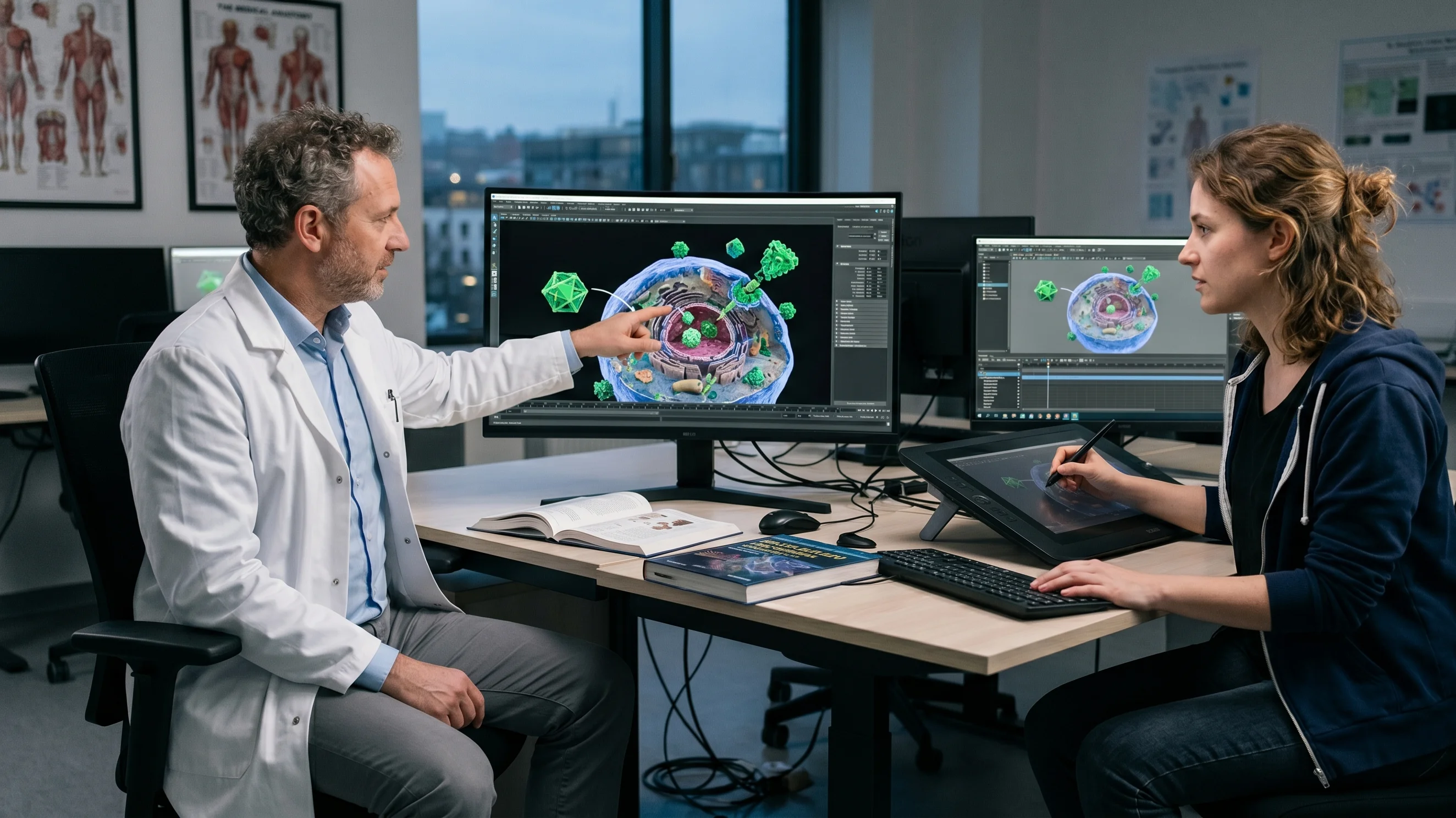
Table of contents
Bringing a new drug to market often faces a "translation" hurdle: how to quickly demonstrate a product’s unique value when its mechanisms happen at a microscopic level? Difficult scientific concepts slow down communication with healthcare professionals (HCPs) and make therapies harder for patients to understand.
This is why more pharma and biotech teams turn to mechanism-of-action (MoA) videos. In this article, we break down the full process of producing an effective MoA animation. You will learn what to expect at each stage and how to turn complex science into a clear visual story.
What is a MoA animation, and why is it essential?
Mechanism of action animations are 3D videos that visually depict how a drug interacts with the body at molecular, cellular, or systemic levels. They show specific targets like receptors or pathways that the drug affects to produce therapeutic effects.
The benefits of this animation type are the following:
-
Simplifies complex concepts. They transform invisible molecular interactions, such as how a drug binds to a specific receptor, into a clear visual narrative. In the end, such animations are easier to grasp than text-heavy clinical descriptions.
-
Enhances knowledge retention. Studies show that visual storytelling significantly improves the viewer's ability to recall information compared to reading static data or listening to a lecture.
-
Standardizes the message. Animation helps pharma companies present complex science consistently across both internal teams and external audiences.
-
Accelerates HCP engagement. MoA animation can aid scientific papers in explaining a drug’s unique value proposition faster and more effectively.
-
Saves time and costs in training. They serve as a universal educational resource for onboarding new staff or training global sales teams without the need for constant in-person sessions.
These benefits turn MoA animation into a versatile marketing asset. A single high-quality video can be repurposed for trade show booths, social media, investor pitches, and dedicated medical training apps.
The 7-step process of producing the MoA animation
Creating a high-impact MoA animation is a delicate balance between cinematic storytelling and scientific precision. It requires a structured workflow to ensure that complex pharmacological or biological interactions are visually stunning and clinically accurate.
1. Client meeting
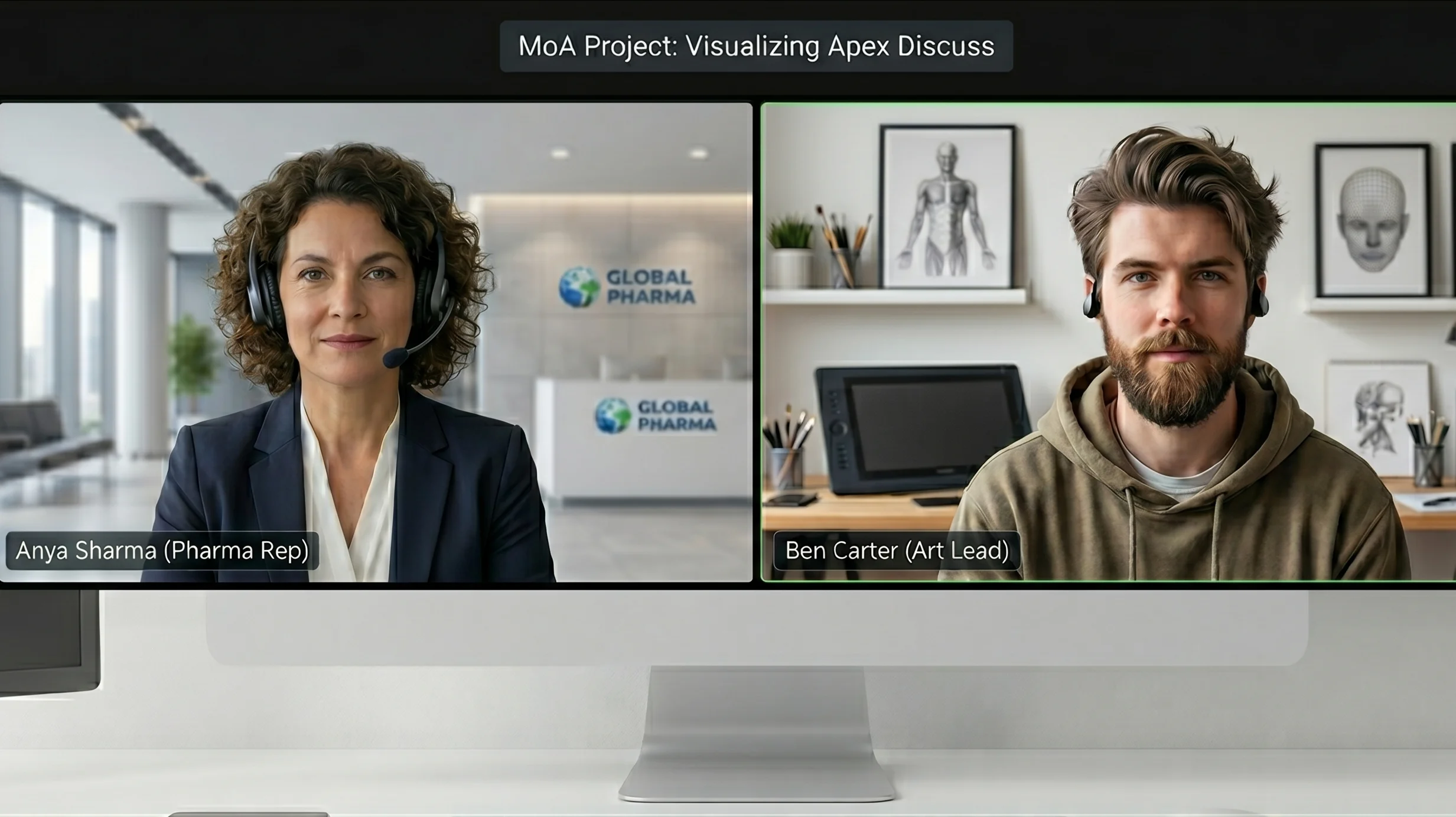
The very first step of MoA animation production is a client meeting. Its goal is to discuss the future project in detail. The meeting points typically include:
-
Getting acquainted with the team. You receive a more detailed description of the production agency, learn more about their experience, and see the people who would be working on a project.
-
Defining the objectives. As a client, you share your goals and plans for using the animation. For example, whether it will be used in medical learning, clinical practice, or in marketing materials.
-
Discussing requirements. Here, the main focus is on defining technical traits of the animation, such as duration and format. Additionally, the initial production deadlines are set.
2. Scientific research
Once the project scope is clarified, the process gets to the scientific research stage. It is one of the most important steps because it ensures the scientific accuracy of the final animation.
VOKA has an in-house team of doctors integrated into video production workflows. They provide valuable clinical insights that prevent narration errors and ensure regulatory compliance.
As an outcome of the research phase, we come back with a commercial offer in which we propose a scenario approved by our medical team. At this stage, we also finalize the resource estimation, timelines, and budget.
The research phase is where we transform raw data into a precise roadmap. We review the science at the high-level scenario stage to eliminate inaccuracies before a single frame is rendered. This collaborative approach allows us to provide clients with a realistic scope that respects both the complexity of medicine and the requirements of the project.

3. Scriptwriting and storyboarding
When all the necessary data is gathered, the production team creates an animation script. This milestone extends the initial scenario. Here we describe each scene, highlighting the most crucial moments. At this stage, there is a high level of flexibility in changing sequences and paces, while staying within a hard cap on effort.
Some agencies may ask their clients to provide a detailed script. However, at VOKA, we write it from scratch, according to the customer's needs and requirements.
After the script has been approved, the animation team starts the storyboard development. An animation storyboard is a sequence of sketches or drawings arranged in chronological order to represent the key moments of the future video. In other words, it provides a visual understanding of compositions and timings.
A professional animation storyboard typically contains:
-
Frames. Rough sketches showing what the viewer sees.
-
Voiceover notes. Short summaries of spoken lines.
-
Action notes. Description of movements, effects, or scene changes.
-
Camera directions. Close‑ups, wide shots, pans, zooms.
-
Scene/shot numbers. Data to keep the sequence organized.
-
Timing notes. How long actions or shots last.
At VOKA, storyboards are created by the project’s art director, combining scientific accuracy with strong visual storytelling from the very beginning. The result is dynamic, understandable, and visually pleasing at the same time. Medical specialists are involved throughout the process to review important scientific details and ensure the animation stays accurate.
Both the script and storyboard align the client and production team before animation begins. They turn abstract ideas into a clear visual plan, making it easier to agree on pacing, visuals, key messages, and overall direction early in the process.
4. 3D modeling and animatic creation
The next stage is about bringing the animation concept and the static storyboard to life.
First, the 3D artists create custom 3D medical models. These assets represent organs, tissues, cells, and various anatomical layers with the highest quality and scientific precision. If the project includes a medical device, the device itself is also modelled in 3D.
Depending on the project, these assets can be developed from client-provided data or created from scratch. In most cases, medical device models are fully built by the production team.
Once all the models are ready, the production team moves on to the animatic stage. An animatic is an animated storyboard, a sequence of frames edited together into a video.
It typically includes:
-
The sequence of frames arranged to match the narration.
-
Shot timing (the duration of each frame on screen).
-
Rough camera movements, such as zooms, tilts, and pans.
-
Basic motion cues.
At VOKA, we use a slightly different production approach where objects and camera movements are animated early in the pipeline. This helps clients see a more complete version of the video at an early stage — still unpolished, but already close to the final result in terms of structure and flow.
Animatic creation is essential for several reasons:
-
It defines pacing and timing.
-
Provides the possibility for early revision.
-
Helps estimate and align the production team’s workload.
-
Allows for identifying storytelling issues early.
It's still not the final version, but it gives the client a visual understanding of the narration.
Visualizing the final result can be challenging in the early stages, as raw animation often lacks the nuance of lighting and textures. To bridge that gap, we provide Look Dev stills for key scenes, giving you a clear and accurate preview of the final aesthetic

5. Voiceover and sound design
At this stage, we add the voiceover to give the animation its spoken narrative. We work from the approved script (either created by our team or provided by the client) and record a professional narration that matches the tone and pace of the video.
We also design and integrate all additional audio elements. This includes sound effects, ambient audio, and subtle cues that support the visuals and make the experience more immersive without distracting from the scientific content.
6. Texturing, lighting, and rendering
Next, the animation gets colour, volume, and real motion.
We apply textures to every 3D model — adding real-world material properties like skin, tissue, metal, glass, or liquid surfaces. This is what defines how each object looks and how it reacts to light in a realistic way.
Next, we set up the lighting. Our team carefully designs how the scene is lit to create depth, contrast, and focus. Lighting is what helps guide the viewer’s attention and makes the medical structures feel clear.
Finally, we move to rendering. This is where we generate the final frames of the animation. The system processes all models, textures, lighting, and effects together to produce the final visual output.
7. Post-production
When the visual and sound parts are finished and reviewed, the process gets to the final stage. It typically includes:
-
Adjusting lighting, colour, and visual effects.
-
Fixing rendering issues.
-
Audio line editing.
-
Syncing all audio and visual elements.
This process is a standard for most professional studios, though the sequence of steps can differ from company to company.
Key criteria for a successful MoA video
To ensure your MoA animation doesn't just look good but actually achieves its strategic goals, the production studio should prioritise the following points:
1. Adaptation to the target audience
A MoA animation must be strategically fine-tuned for specific B2B audiences. The level of detail and scientific depth will differ depending on whether the video is intended for patients, healthcare professionals, or investors.
When choosing a production partner, it’s important to check if they can already demonstrate this in their portfolio. Strong studios don’t just create one type of video. They show experience in adapting scientific content for different audiences and communication goals.
2. Proven scientific accuracy
In the healthcare and pharmaceutical sectors, visual inaccuracies carry sufficient regulatory and reputational risks. High-quality production must rely on strict medical explainer standards to get through professional legal and medical reviews.
To achieve it, the production agency should have in-house medical experts working at every stage of production. This ensures that creativity doesn’t compromise scientific truth and all assets are fully optimized for regulatory approval.
3. Strong visual storytelling
Effective MoA animations rely on clear visual storytelling that combines scientific accuracy with cinematic quality. The goal is not only to explain complex biological mechanisms but to present them in a visually engaging way.
Each scene should guide the viewer through the mechanism step by step, using composition, motion, and visual hierarchy to make the science understandable and compelling.
Yet, science is still not everything. Beyond technical accuracy, we prioritize the WOW-factor as well. Even when the complexities of molecular science are difficult to grasp, the viewer remains captivated by the sheer cinematic quality, driven by vibrant colour palettes, organic forms, and a compelling visual narrative. It draws their attention, making them rewatch the material and be more attentive.
When selecting a production partner, it’s important to look for a studio that can balance scientific precision with strong visual execution.
Where MoA videos create the most impact
To get the most value from MoA animations, it’s important to look at how they are actually used in pharma communication. Here are the main ways you can use these videos across different stages and channels:
-
Pharma marketing & sales. Instead of navigating complex clinical brochures, sales representatives can use 15-30 second clips during sales sessions to instantly clarify a drug’s competitive advantage and improve brand recall.
-
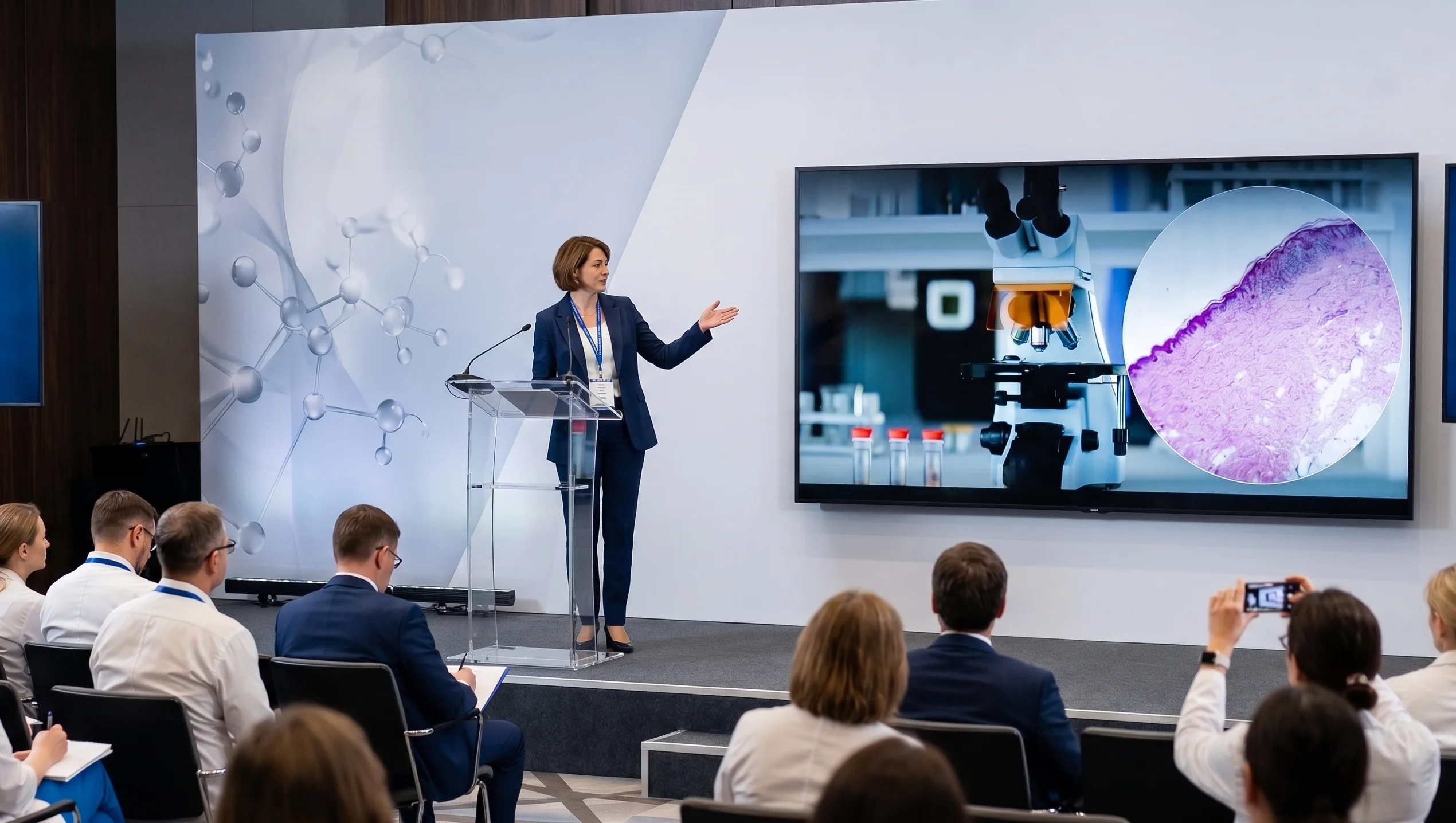
Trade shows & professional events. At major medical congresses or pharma industry events, large-scale 3D animations serve as visual anchors for exhibition booths. They attract foot traffic and facilitate high-level discussions by providing a shared visual reference.
-
Investor relations & discovery funding. For biotech startups and R&D departments, MoA animations are essential for "proof of concept" presentations. They help investors visualize the biotechnological processes, increasing the chances of securing venture capital.
-
Patient education. Clinicians use MoA visuals during consultations to explain how a prescribed treatment works. This transparency builds patient trust, reduces treatment-related anxiety, and improves long-term therapy adherence.
-
Web resources. Integrating high-fidelity animations into product websites or medical portals is a cornerstone of digital transformation in the pharma industry. These visuals reduce bounce rates and keep users engaged longer than text-based pages, significantly boosting the effectiveness of lead nurturing campaigns.
-
Regulatory & MLR submissions. As professional MoA animations are built on precise medical explainer standards, they provide a standardized narrative for Medical, Legal, and Regulatory (MLR) review boards. This ensures that the scientific story remains consistent and accurate across all promotional materials.
-
Mobile apps & interactive training. MoA animations can be integrated as interactive 3D content in dedicated learning platforms and mobile apps. Users can define and track specific cellular events, creating a deep, hands-on learning experience.
Conclusion: partner with VOKA experts for your next MoA video
Creating an effective MoA animation is not just about producing high-quality visuals. It is about translating complex drug mechanisms into a clear visual format.
When done right, MoA videos become a practical tool that helps overcome key industry challenges and support informed decision-making throughout the product lifecycle.
Professional agencies like VOKA know how to transform complex molecular data into medically accurate, high-impact 3D animations that resonate with experts and audiences alike. So, if you need a MoA project of any scale and complexity, don’t hesitate to contact us!
FAQ
1. How long does producing an MoA animation take?
On average, a professional 60-90 second MoA animation takes 5 to 8 weeks to complete. This timeline can be logically divided. Pre-production (scriptwriting and storyboarding) takes around 2 weeks. The production itself, including animatic and voiceover creation, is 2-4 weeks, while rendering, visual effects, and colour corrections can last for an additional 1-2 weeks.
2. How much does it cost to produce an MoA video?
In 2026, pricing typically depends on the level of scientific detail, duration, and deadlines required. A high-end 3D studio may charge between $15,000 and $25,000 per minute, which includes medical board reviews, custom microanatomy modelling, and cinematic rendering.
3. What is the difference between HCP and patient MoA animations?
The core difference between HCP and patient animations lies in the technical density and the ultimate objective. Animations for HCPs focus on high-level terminology and data-rich visuals to support clinical decision-making. Patient animations use relatable metaphors and simplified effects to reduce anxiety and improve treatment adherence.
4. How do MoA animations assist in MLR/PRC reviews?
MLR and PRC teams prioritize accuracy and safety, and animations assist this process by standardizing the narrative. Visual evidence makes it easier for legal teams to see that claims aren't being exaggerated. In addition, scientific animations are easier for regulators to reference against clinical trials than abstract marketing copy.
5. How do animation studios protect confidential pre-launch drug data?
Security is paramount for the industry, so reputable studios employ strict NDAs for all staff. They also use secure infrastructure, such as encrypted cloud servers, for project files. Preliminary versions are often watermarked with confidential markers to prevent unauthorized leaks before the official launch.
Make VOKA your preferred source
See more VOKA articles in Google Search

Share
Table of contents

Thank you for your comment!
Your comment has been submitted for moderation and will be published soon. We'll email you once it’s live.